HELCOM has released a new educational adventure, inviting players to explore, and help save, one of the world’s most threatened marine ecosystems. Baltic Rescue – Match & Track was released today and is available free of charge online as a browser version and downloadable in major app stores.
This engaging match-3 puzzle game, developed in collaboration with Part of Noise Games and funded by the Nordic Council of Ministers, raises awareness of the environmental pressures impacting the Baltic Sea. Players embark on a virtual diving journey through six unique locations from the Kattegat to the Bothnian Bay, each highlighting a key regional challenge such as biodiversity loss, sea-based activities, hazardous substances and litter, eutrophication, non-indigenous species as well as climate change.
Guided by Baltic Sea species like the harbour porpoise, blue mussel and ringed seal, players trace symptoms of environmental decline back to the human activities causing them. By solving match puzzles, they unlock new areas, collect Baltic Health Hearts and use them to purchase real-life tools and measures that help improve the sea’s condition.
Designed for both desktop and mobile devices and suitable for ages 8 and up, Baltic Rescue – Match & Track turns players into “diving detectives” who investigate, identify root causes, and take action to restore the health of the Baltic Sea.
How HELCOM’s new strategic approach is reshaping the regional response to hazardous substances in the Baltic Sea.
Water pollution concept. Woman scientist takes a water sample from polluted pond.
Laying the groundwork: strategic review for change
By the end of 2010s, HELCOM’s work on hazardous substances was still focused on a relatively limited number of substances. Actions and HELCOM Recommendations were often developed on an ad hoc basis and were not systematically linked to regularly updated assessments of the marine environment or pollutant loads. The regional context had also changed significantly since the Helsinki Convention was negotiated: by 2004, eight of nine HELCOM Contracting Parties were also EU member states, and chemicals regulation had become largely harmonized at the EU level.
Work began in spring 2020 on a comprehensive review of the HELCOM framework on hazardous substances. The review was carried out in cooperation with the Baltic Sea Centre of Stockholm University and supported by the Swedish Agency for Marine and Water Management, with all HELCOM Contracting Parties actively participating.
In 2021, a background report on an update of HELCOM work on hazardous substances in the Baltic Sea was published. The review concluded that while an existing HELCOM Recommendation had set out general principles for work on hazardous substances, there was no systematic mechanism for regularly updating the list of priority substances. Such a mechanism was needed to ensure that decisions were based on the latest data on inputs, environmental status and emerging substances of concern. HELCOM’s role in relation to other regional and EU-level policies also needed to be clarified, with a focus on identifying the specific added value of HELCOM’s activities.
These findings informed the 2021 update of the HELCOM Baltic Sea Action Plan (BSAP), through which the HELCOM Contracting Parties committed to several key actions. These included developing a regional strategic approach for managing hazardous substances, establishing a mechanism for managing the HELCOM list of priority substances, setting up procedures to use and build on data from other policy frameworks as well as updating the priority substances list and developing a regional action plan.
From strategic review to strategic approach
The development work began in October 2022. It was supported by two dedicated projects, HAPHazard and HAZ-SHAP, which ensured sufficient resources for the work. Clear requirements were defined for the new framework:
It should promote a truly holistic assessment of hazardous substances, covering a broad range of chemicals
It should link actions to the outcomes of the assessment, ensuring that measures target the most relevant substances and issues, including data and knowledge gaps
It should actively interact with existing policies, both by utilizing data generated by them and by influencing their further development, ensuring that HELCOM actions provide added value to – and function in synergy with – existing policies.
To inform the design, paradigms and mechanisms used under other policies or organizations, as well as examples from scientific literature, were reviewed to identify relevant elements for the regional marine framework. These insights, combined with creative development work, helped to define a high-level conceptual structure for the framework.
A series of informal consultation sessions of HELCOM’s Expert Group on Hazardous substances (EG Haz) and several ad hoc meetings helped to refine the concept into a fully functional mechanism. This was a systematic and iterative process, where national experts contributed knowledge, feedback and suggestions on optimizing the various parts of the framework’s mechanism. Throughout the whole process, the HELCOM Working Group on Source to Sea Management of Nutrients and Hazardous Substances and Sustainable Agricultural Practices (WG Source to Sea) provided overarching strategic guidance. By the end of 2023, a draft but operational version of the regional strategic approach was ready for testing – or rather its ‘primary run’. The finalized regional strategic approach consists of four main steps:
Holistic assessment of the state of the environment (levels of chemicals and observed biological effects), human activities and pressures (e.g. inputs to the Baltic Sea via different pathways).
Identification of substances or groups of substances of possible concern for the Baltic Sea, based on established criteria.
Updating of three priority lists (substances, sources of release, uncertainties to address).
Use of these lists as complementary perspectives to inspire adoption of measures of added value, following an analysis of the effectiveness and gaps in existing measures.
The approach was designed to be both flexible and systematic and to account for differences in the availability of data and resources as well as policy priorities. It ensures that each piece of information contributes clearly to understanding of the overall picture. The systematic structuring of available information also facilitates the identification of knowledge gaps in data or methodologies, helps express uncertainties and allows for easy integration of new scientific developments and data. Special attention was given in balancing the need for evidence with the precautionary principle.
The framework operates in recurring six-year cycles, designed to align with and draw data from other HELCOM processes ( HOLAS , PLC ) or regulatory frameworks (MSFD, WFD, REACH, etc.). In turn, the framework can support these processes by providing a basis for proposing new indicators and strengthening coordination of monitoring programmes, programmes of measures and regulatory actions.
Testing the approach: Short and long-term impacts
The year 2024 marked the first full application of the new approach. Key data sources were identified and used to support a holistic assessment that ultimately covered around 1,500 substances and substance groups. In parallel, several projects provided deeper insight into specific parts of the assessments, including biological effects, pharmaceuticals, PFAS substances and on non-target and suspect screening.
The careful design of the framework, its principles, definitions and mechanisms proved effective. It not only improved the efficiency of the process but also helped regional discussions focus on the specific characteristics of substances and the selection of appropriate policy options.
The work led to direct results, such as three agreed priority lists and 55 fact sheets, providing overviews for each highlighted substance or substance group, a tested regional strategic approach as well as a regional action plan on hazardous substances in preparation, outlining HELCOM’s role in relation to other policy frameworks.
One key realization from this process was that although one of the priority lists (‘Horizontal uncertainties to address’) still contained a number of priority needs, overall the gaps had been significantly reduced compared to the situation before the primary run.
There were also valuable indirect outputs. New databases were established for the Baltic Sea and its catchment area, compiling information on marine concentrations and estimated inputs for numerous substances and groups, based on data from national and international databases, screening campaigns, scientific articles and reports and using automated tools.
Ther long-term impacts of this work are expected to include new HELCOM indicators based on newly listed HELCOM priority substances, support to EU-level processes such as the Water Framework Directive (WFD) and the Marine Strategy Framework Directive (MSFD) as well as stronger, better coordinated regional work. The three priority lists convey a clear message to authorities and stakeholders, helping them focus on mitigating the highest risks and on addressing key knowledge gaps or methodological gaps.
Looking ahead: Building synergies and shared tools
Throughout the development and implementation, collaboration with other Regional Sea Conventions and organisations brought mutual benefits through shared expertise. These exchanges laid the foundation for future cooperation and joint initiatives. A great example is the Harmonised Regional Seas Assessment Tool (HARSAT) tool, a collaboration between the Baltic, North-east Atlantic and Arctic Regional Seas Conventions, supported by ICES, consultants and members of the relevant expert groups. This openly available tool improves the efficiency of statistical analysis of contaminant data in marine samples, enhancing indicator evaluations for hazardous substances across regions.
Written by Vasileios Kouloumpos, Project Researcher, HELCOM
This article was first published by UNEP in their StoryMapRegional Seas: Transforming Oceans, Empowering People
Whether you are an environmental manager shaping policy, a researcher exploring new findings or a young learner curious about the Baltic Sea, this material bank provides accessible, engaging and informative content, including briefs, online game, videos and more.
The material bank offers a wide range of products tailored for different users:
Briefs for scientists and policymakers, offering new perspectives on Baltic Sea-related topics
An action leaflet with practical, research-based steps to support our beloved sea
Through these materials, HELCOM seeks to foster ocean literacy and deepen understanding of the Baltic Sea’s ecosystems, challenges and opportunities. Dive in and explore a wealth of knowledge to support a sustainable future for the Baltic Sea!
This September, HELCOM and PROTECT BALTIC proudly took part in World Cleanup Day 2025, mobilizing efforts along the Finnish coast to tackle the growing challenge of marine litter.
Photo: HELCOM
Cleanup activities were held in Mustikkamaa in Helsinki and on the beaches of Uniluoto, Yyteri, and Kallo in Pori.
The events brought together enthusiastic young volunteers who dedicated their time and energy to collecting litter from shorelines and raising awareness of how pollution affects the Baltic Sea.
Plastic waste, cigarette butts, and other discarded items were removed from sensitive coastal environments, preventing them from entering marine ecosystems where they can harm wildlife and degrade habitats.
Photo: Kimmo Koivumäki
Beyond the immediate impact of removing waste, the cleanups also became a platform for dialogue and awareness-raising with the wider community. Curious passers-by stopped to ask questions, join short discussions, and learn more about how marine litter affects the Baltic Sea. These spontaneous interactions provided opportunities to highlight how everyday choices, such as reducing single-use plastics and disposing of waste responsibly, can make a difference.
By engaging both volunteers and onlookers, the events helped connect local action with HELCOM’s broader regional efforts to combat marine litter, an issue recognized as one of the key pressures on the Baltic Sea environment.
Photo: Kimmo Koivumäki
World Cleanup Day is a global initiative uniting millions of people across more than 150 countries in a single-day effort to address litter on 20 September. By joining this movement, HELCOM and PROTECT BALTIC underline the importance of collective action in achieving a cleaner and healthier Baltic Sea.
Contact
Paul Trouth Communications Coordinator paul.trouth@helcom.fi
The Baltic Sea needs urgent action. Ecosfera Baltica, a new educational board and online game, transforms science into interactive play — inviting players to work together to restore the sea.
Helsinki, FINLAND – August 28, 2025 – HELCOM, the Baltic Marine Environment Protection Commission, together with Julibert Games and Reaktor, today launched a new game where players team up with the shared mission of saving the Baltic Sea. By turning complex ecological concepts into accessible gameplay, the game demonstrates how play can foster environmental understanding and inspire action for a more sustainable future.
Ecosfera Baltica is an educational, cooperative multiplayer game that immerses players in the fragile marine ecosystem of the Baltic Sea. Offered both as a classic board game and a free interactive online version, it invites players to team up, make strategic decisions, and tackle environmental threats, all while having fun.
The Baltic Sea’s condition is becoming increasingly critical, as pollution, marine biodiversity loss, and a changing climate push its ecosystems. Rooted in science and inspired by the findings of HELCOM’s State of the Baltic Sea 2023 report, Ecosfera Baltica encourages players to broaden their understanding of ecological principles, marine species and habitats and most importantly: the value of collaboration.
“It is amazing how well the complex Baltic Sea ecosystem can be translated into a board and online game,” said Jannica Haldin from HELCOM. “Ecosfera Baltica lets us explore our relationship with the environment. While we can cause harm, we also have the power to provide solutions or prevent damage. The game has strong educational value, but these aspects are subtly built into the gameplay as the main focus is on a varied and exciting gaming experience”.
Designed for players aged 8 and up, the game is colorblind-friendly and largely language-independent. Rulebooks are currently offered in eight languages: English, Finnish, Swedish, Estonian, Danish, German, Russian, and Lithuanian, with more Baltic Sea languages on the way. To support environmental education, over 1,500 copies of the board game will be distributed free of charge to schools, libraries, and public institutions across the Baltic Sea region. The digital version, developed together with Reaktor, is open-access and globally available.
“For Reaktor, the development of the online version of Ecosfera Baltica has been both rewarding and exploratory. Saving the Baltic Sea is a mission we strongly support as a company, and it was inspiring for our team to figure out how to bring the board game experience online,” says Pauliina Luhtanen, SVP for Gaming at Reaktor.
The development of Ecosfera Baltica was made possible through the support of the Maj and Tor Nessling Foundation.
For anyone interested in trying out Ecosfera Baltica, either as a board game or in its digital version, the game will be showcased today, 28 August, at the EU@Oodi stand on the first floor of Oodi as part of the Baltic Sea Festival, from 12:00 to 19:00.
The Baltic Marine Environment Protection Commission – also known as the Helsinki Commission (HELCOM) – is an intergovernmental organisation (IGO) and a regional sea convention (the Helsinki Convention) in the Baltic Sea area. A regional platform for environmental policy making, HELCOM was established in 1974 to protect the marine environment of the Baltic Sea from all sources of pollution. The headquarters of HELCOM, the Secretariat, is in Helsinki. helcom.fi
About Reaktor
Reaktor is a global technology and design consultancy solving highly complex, mission-critical challenges in the most demanding industry sectors. Reaktor’s expertise spans the full lifecycle of problem-solving — from pioneering data and AI to strategy, design, development, delivery and continuous services — anchored in deep industry know-how and high-performing teams. Founded in 2000, Reaktor has 700 employees and offices in Helsinki, Turku, Tampere, New York, Amsterdam, Lisbon, Stockholm, and Tokyo. Reaktor’s clients include Adidas, HBO, Supercell, Cathay Pacific, and KONE. reaktor.com
About Julibert Games
Julibert Games is an independent board game publisher from Finland, specializing in educational games and firmly committed to producing games with a minimal environmental footprint. All Julibert Games titles are produced in Europe with carbon-neutral processes using energy sourced entirely from renewable origins. julibert.com
Media contacts
For HELCOM Eeva Nyyssönen Communication Secretary, HELCOM eeva.nyyssonen@helcom.fi +358 40 647 3996
For Reaktor Anne Karumo Head of Communications and Marketing anne.karumo@reaktor.com +358 44 493 8533
The Baltic Sea Action Plan Fund has opened a new call for proposals aiming to improve the ecological state oThe Baltic Sea Action Plan Fund has opened a call for proposals, providing a funding opportunity for projects addressing key challenges facing the Baltic Sea. The fund can finance projects with the objectives and activities outlined in the Baltic Sea Action Plan to commercial or non-commercial partners for projects in the Baltic Sea region and its catchment area. Proposals will be accepted until 18 April.
The Baltic Sea Action Plan (BSAP) Fund is an early-stage financing mechanism dedicated to expediting the implementation of the HELCOM Baltic Sea Action Plan, which includes 200 concrete actions to be carried out by 2030, with the ultimate goal of creating a healthier Baltic Sea.
The BSAP Fund has now opened a new call for proposals, providing a funding opportunity for projects that address key challenges facing the Baltic Sea. New project proposals will be accepted until 18 April.
Financing can be awarded to commercial or non-commercial actors for projects in the Baltic Sea Region and its catchment area for demonstration purposes, project preparation and development, project implementation and institutional support. Applicants and projects that have previously received funding from the BSAP Fund are also eligible to apply. Read more about the application process and eligibility criteria and find the application form on nefco.int/BSAP.
Concrete projects supporting the Baltic Sea Action Plan
Since the establishment of the BSAP Fund in 2010, contributions from Finland and Sweden have totalled EUR 15 million, enabling the Fund to finance more than 70 projects. During the Fund’s 2023 financing round, EUR 1 million was granted for ten new projects to improve the health of the Baltic Sea.
Sectors financed by the BSAP Fund must address one or several areas highlighted in the Action Plan, including biodiversity, eutrophication, hazardous substances, sea-based activities and the elimination of HELCOM Hotspots.
If you have questions regarding the application process or the eligibility criteria, you can contact bsapfund@nefco.int
About the Baltic Sea Action Plan Fund
The aim of the Baltic Sea Action Plan Fund is to help fund concrete projects, large or small, initialise promising solutions that can be scaled up, regardless of national borders. Since its establishment, the fund has financed over 70 projects. Currently, 15 projects are ongoing and 59 have been completed. These projects are spread out across the Baltic Sea watershed, including in Estonia, Finland, Lithuania, Poland and Sweden. The Baltic Sea Action Plan Fund is co-managed by Nefco – the Nordic Green Bank – and the Nordic Investment Bank and funded by the governments of Finland and Sweden.
For further information about the BSAP Fund, please contact:
Dennis Hamro-Drotz, BSAP Fund Manager/Senior Programme Manager, Nefco dennis.hamro-drotz@nefco.int, +358 10 6180 641
The HELCOM Stakeholder Conference 2025, a one-day online event dedicated to discussing hazardous substances in the Baltic Sea, will take place on 31 March 2025, from 10:00 to 16:00 EEST. Under the theme of the ‘One Baltic’ approach, the conference will explore the latest advancements in applying a holistic approach to managing hazardous substances to ensure a cleaner and healthier Baltic Sea.
The event is open to everyone, but pre-registration is required. Registration for this event has now closed.
The conference aims to bring together stakeholders from HELCOM Contracting Parties, industry representatives, NGOs, international organizations, civil society groups, and other interested individuals to discuss key actions supporting the Baltic Sea Action Plan (BSAP) goal: ‘A Baltic Sea unaffected by hazardous substances’.
The discussions will focus on implementing BSAP actions and the upcoming Regional Action Plan on Hazardous Substances (RAP HAZ), set to be finalized in 2025. Key topics include the current state of hazardous substances in the region, the impact of PFAS regulations, the risks associated with pharmaceuticals in the Baltic Sea, and the importance of a holistic regional approach to managing hazardous substances.
For more information and to view the provisional programme on the event page.
HELCOM has updated its data page to offer a more accessible and user-friendly experience, ensuring that all its data products are now easier to find and navigate.
HELCOM collects and maintains a wealth of data on the Baltic Sea, organizing it into various thematic databases accessible through online data portals and services. The newly updated page provides a clearer overview of these resources, making it simpler for users to explore and utilize the information.
HELCOM’s data products can be categorised in four groups:
Databases: HELCOM hosts, co-hosts or contributes to 12 databases, covering key topics such as shipping accidents and oil spills. These databases are regularly updated, following regionally agreed reporting formats and quality assurance procedures.
Data services: Beyond data access, HELCOM also offers data services that enable machine-to-machine communication, allowing GIS professionals, developers, and researchers to seamlessly integrate HELCOM datasets into their workflows.
Data services: A variety of software tools, developed specifically for HELCOM assessments, are also available through HELCOM’s GitHub repositories.
Rüdiger Strempel, Executive Secretary of HELCOM, reflects on Finland’s special connection with HELCOM and the organisation’s regional efforts to protect the Baltic Sea
On 18th March 1974, the Finnish Postal Service issued a stamp and first-day cover to commemorate the Diplomatic Conference on the Protection of the Marine Environment of the Baltic Sea Area. Four days later, the Conference adopted the Convention on the Protection of the Marine Environment of the Baltic Sea Area, or Helsinki Convention. This was a milestone in a process in which Finland has continuously played a pivotal part. In this article, I would like to recall why a story that began more than fifty years ago still matters – and the special role of Finland in writing it.
The commemorative stamp depicted a flock of seagulls above a deep blue sea and bore the inscription “The Baltic Sea – our environment” in Finnish and Swedish. Sadly, however, by the 1970s, that environment was severely compromised, and the Baltic Sea was considered the most polluted sea in the world. Without decisive action on the part of the Baltic Sea states, it was at risk of spiralling into the abyss of ecological apocalypse.
Regional efforts to protect the Baltic Sea since 1972
In 1972, Finland spurred those states to action. An initiative that Finland, due to its special role in the bipolar Cold War world order, was uniquely well-placed to take and that matched the overall fabric of the country’s foreign policy. In the course of 1973, it hosted and chaired three intergovernmental expert meetings on the Baltic Sea in Helsinki, bringing together the then-seven Baltic Sea states: Denmark, Finland, the German Democratic Republic, the Federal Republic of Germany, Poland, the Soviet Union, and Sweden.
These efforts were crowned with success, and by early 1974, the process was brought to a successful conclusion at the Diplomatic Conference.
It took another six years for the agreement, a front- runner in international marine environmental law as the first international treaty globally to protect a regional sea from all sources of pollution, to enter into force. During that time, the governing body provided for in the Convention, the Helsinki Commission (HELCOM), met six times in a provisional format, the so-called Interim Commission (IC).
Finland hosted and chaired all six of those meetings, as well as roughly one-fourth of the meetings of the technical Working Groups established by the IC. It also provided an interim Secretariat. In 1980, the Commission’s first regular meeting occurred in Helsinki, and the permanent HELCOM Secretariat was established. It became the first international organisation to permanently establish its headquarters in the Finnish capital, where it is still located today.
And Finland’s close involvement with HELCOM continued beyond the inception phase. As the organisation’s host country, it has continuously supported HELCOM work both financially and substantively. Finland has hosted four HELCOM Ministerial Meetings – more than any other country. Moreover, when the geopolitical changes of the late 1980s and early 1990s and advancements in international environmental law and policy necessitated a revision of the Convention, Finland again played a key role in facilitating this process and ensuring that HELCOM remained fit for purpose.
In April 1992, Helsinki’s iconic Finlandia Hall was the venue of another Diplomatic Conference under Finnish chairmanship, which adopted the revised Helsinki Convention. The 1992 Convention has ten Contracting Parties, all Baltic Sea States, and the European Union, reflecting the geopolitical realignment following the collapse of the Soviet Union and the Eastern Bloc. In force since 2000, it has stood the test of time and remains the basis of HELCOM’s work to this day.
And that work is crucially important. Water knows no boundaries, and no one country can achieve marine protection on its own. For five decades, HELCOM has provided Baltic Sea states with a platform for the regional exchange, dialogue and cooperation required to tackle the formidable challenges faced by their common sea. It is a multilateral success story, leading to improvements in the state of the Baltic Sea environment and thereby benefitting nature and people across the region.
Yet, it has not been an unqualified success. The condition of the Sea remains deplorable, as documented by the third Holistic Assessment of the State of the Baltic Sea (HOLAS 3), published by HELCOM in 2023. Already ailing, our sea is severely affected by the triple planetary crisis of climate change, biodiversity loss and pollution. But the assessment also offers hope. Decades of monitoring and assessment under the auspices of HELCOM have vastly expanded our knowledge of the Baltic Sea.
Moreover, HOLAS 3, the most comprehensive assessment of its kind to date, also shows that if duly implemented, regional measures will lead to an improvement in the sea’s condition.
HELCOM’s 2021 Baltic Sea Action Plan (2021 BSAP) lays out a broad range of such measures, along with a roadmap for their implementation, clearly indicating what needs to be done and by when. While the costs of such measures may seem daunting, the high cost of inaction, also evidenced by HOLAS 3, makes them a critically important long-term investment that we cannot afford not to make.
Achieving good environmental status for the Baltic Sea
Fifty years after HELCOM’s establishment, the organisation’s job is far from done, and protecting the Baltic Sea requires continued, sustained multilateral efforts. It can, therefore, reasonably be said that if HELCOM did not exist, it would need to be invented. Fortunately, however, it does exist.
While the current challenging geopolitical situation has forced the organisation to modify its operational procedures, it remains largely on track in implementing the 2021 BSAP. In line with the bold vision that originated in Finland over half a century ago, HELCOM is poised to continue catalysing and crystallising joint regional efforts towards achieving good environmental status for the Baltic Sea – our environment.
This article was first published in Open Access Government. The views expressed in this article are those of the author and do not necessarily reflect those of HELCOM or its Contracting Parties.
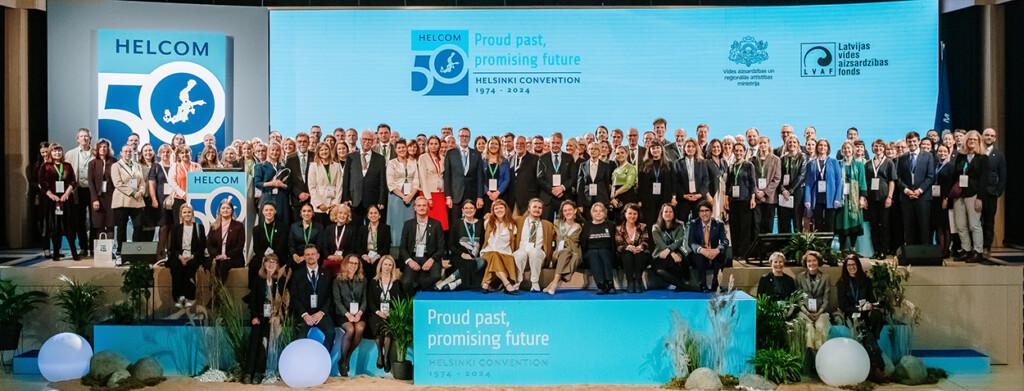
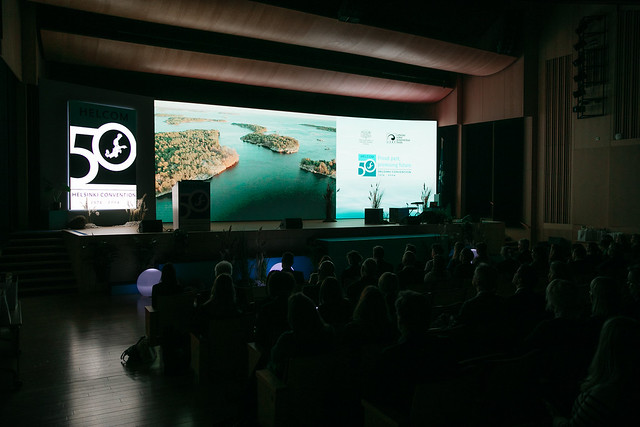
For HELCOM, 2024 has been a truly special year, marking the organization’s 50th anniversary. On April 25th, 2024, this milestone was celebrated with a special event in Riga, Latvia. Hosted in the impressive Ziedonis Hall at the Latvian National Library, the occasion brought together distinguished speakers, panelists, and approximately 150 participants from across and beyond the Baltic Sea region.
To conclude our 50th anniversary celebrations, we are delighted to present a commemorative volume. This publication features the insightful and thought-provoking contributions of the speakers, panelists, and moderators from the Riga event. It also includes rarely seen images that capture moments from HELCOM’s 50-year history.