Organisation
The Baltic Marine Environment Protection Commission – also known as the “Helsinki Commission” or “HELCOM” – was established in 1974 pursuant to and at the same time as the Convention on the Protection of the Marine Environment of the Baltic Sea Area (the “Helsinki Convention”).
The Helsinki Commission meets annually, with all Contracting Parties participating: Denmark, Estonia, the European Union, Finland, Germany, Latvia, Lithuania, Poland, Russia and Sweden. In addition, meetings at the Ministerial level are held every few years (usually every three years). The Contracting Parties are represented by Heads of Delegation (HOD).
The Commission adopts Recommendations related to the protection of the marine environment and sustainable maritime activities, decides on the budget and makes other key decisions. Decisions are made by consensus.
The chairmanship of the Commission rotates between the Contracting Parties every two years, according to their alphabetical order in English, the working language of the Commission.
The working structure of HELCOM consists of the meetings of the Helsinki Commission, the Heads of Delegation, and the eight main HELCOM Working Groups. The HELCOM work and meetings are coordinated by the HELCOM Secretariat.
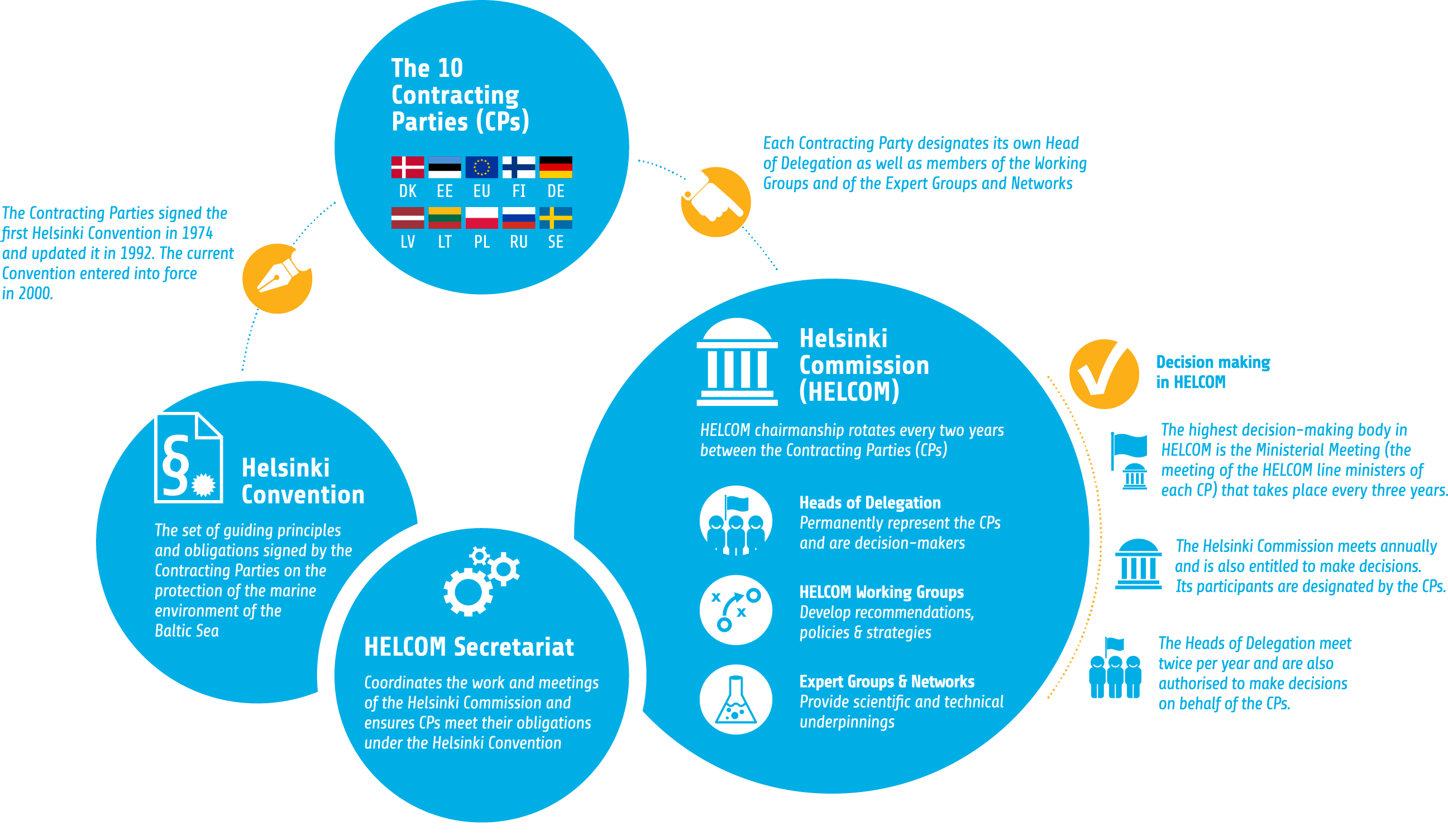
HELCOM has 10 Contracting Parties: Denmark, Estonia, the European Union, Finland, Germany, Latvia, Lithuania, Poland, Russia and Sweden.
The Contracting Parties are the signatories to the Helsinki Convention.
The HELCOM Secretariat coordinates the work and meetings of the Helsinki Commission, and ensures that the contracting Parties meet their obligations under the Helsinki Convention.
The international team is led by the Executive Secretary. About half of the staff members perform permanent secretariat functions, with the other half working for projects.
The HELCOM Secretariat is located in Helsinki, Finland.
The Helsinki Convention is the set of guiding principles and obligations signed by the Contracting Parties on the protection of the marine environment of the Baltic Sea.
Its official title is the “Convention on the Protection of the Marine Environment of the Baltic Sea Area”.
It was initially signed on 22 March 1974, and updated on 9 April 1992. The updated and current Convention entered into force on 17 January 2000.